A 10-Step Workflow for NLP Shared Tasks on a Small Compute Budget
How to spend limited compute in an NLP shared task: a three-phase, 10-step workflow from my doctoral thesis.
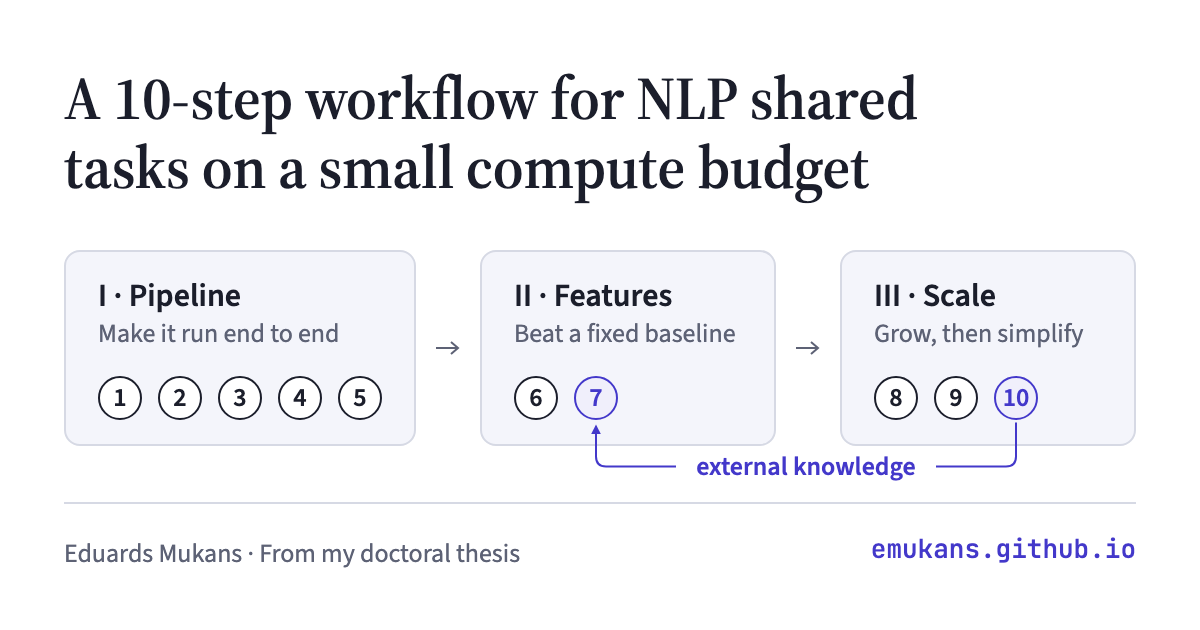
I have recently submitted my doctoral thesis, Application of Large Language Models for Input Context Enrichment in NLP Pipelines, for review. This post is adapted from one of its sections: the development workflow we used across four SemEval and SMM4H shared tasks between 2022 and 2025, together with my supervisor Guntis Barzdiņš.
A shared task gives you a fixed dataset, a fixed metric and a hard deadline. With a small compute budget, the question that matters is how to spend your GPU hours so that few of them go into dead-end experiments. The workflow below is our answer: 10 steps in three phases. Step 10 loops back to Step 7: when the training data has no more features to give, bring in external knowledge.
Phase I: get a working pipeline (Steps 1–5)
The goal is an end-to-end pipeline that runs. Performance does not matter yet.
- Start with the smallest model. Take the base variant, not the large one. A small model surfaces pipeline bugs as well as a big one does, at a fraction of the cost.
- Train on the development subset first. A full cycle should take minutes, not hours.
- Time-box the first runs to a few epochs or a few minutes. Check that metrics are logged correctly and that the output is not degenerate.
- Train on plain, unmodified data. This is the sanity check before any feature work.
- Read the outputs yourself. Automatic metrics can miss real progress, or reward a model that repeats frequent phrases. We ran into this in our first task (2022).
Parameter-efficient methods such as adapters suit this phase well: they are fast and stable. Just don’t expect them to give your best final score (2023).
Phase II: develop features (Steps 6–7)
- Train a baseline on the full training set. Its score is the reference for every later experiment.
- Add features one at a time, and test each at small scale first. If a feature does not move the metric but the outputs look better on inspection, keep it for a larger test.
Phase III: scale and refine (Steps 8–10)
- Scale the model once the features work. Scaling can absorb some features completely.
- Drop redundant features. If two configurations score the same, keep the simpler one.
- Repeat the feature cycle at the new scale. When the training data has no more features to give, bring in external knowledge: LLM-generated context about the input (2023, 2024) or a curated database (2025).
For the final runs, train the full model and don’t rely on early stopping. In our experiments the task metric kept improving well after the validation loss had stopped (2022, 2023).
Papers and code
The details of each task, with results and ablations, are in the original papers:
- 2022 · RIGA at SemEval-2022 Task 1: Scaling Recurrent Neural Networks for CODWOE Dictionary Modeling. Paper · Code
- 2023 · RIGA at SemEval-2023 Task 2: NER Enhanced with GPT-3. Paper · Code
- 2024 · RIGA at SMM4H-2024 Task 1: Enhancing ADE Discovery with GPT-4. Paper · Code
- 2025 · RIGA at SMM4H-HeaRD 2025: Context-Enriched Classification Pipeline. Paper · Code